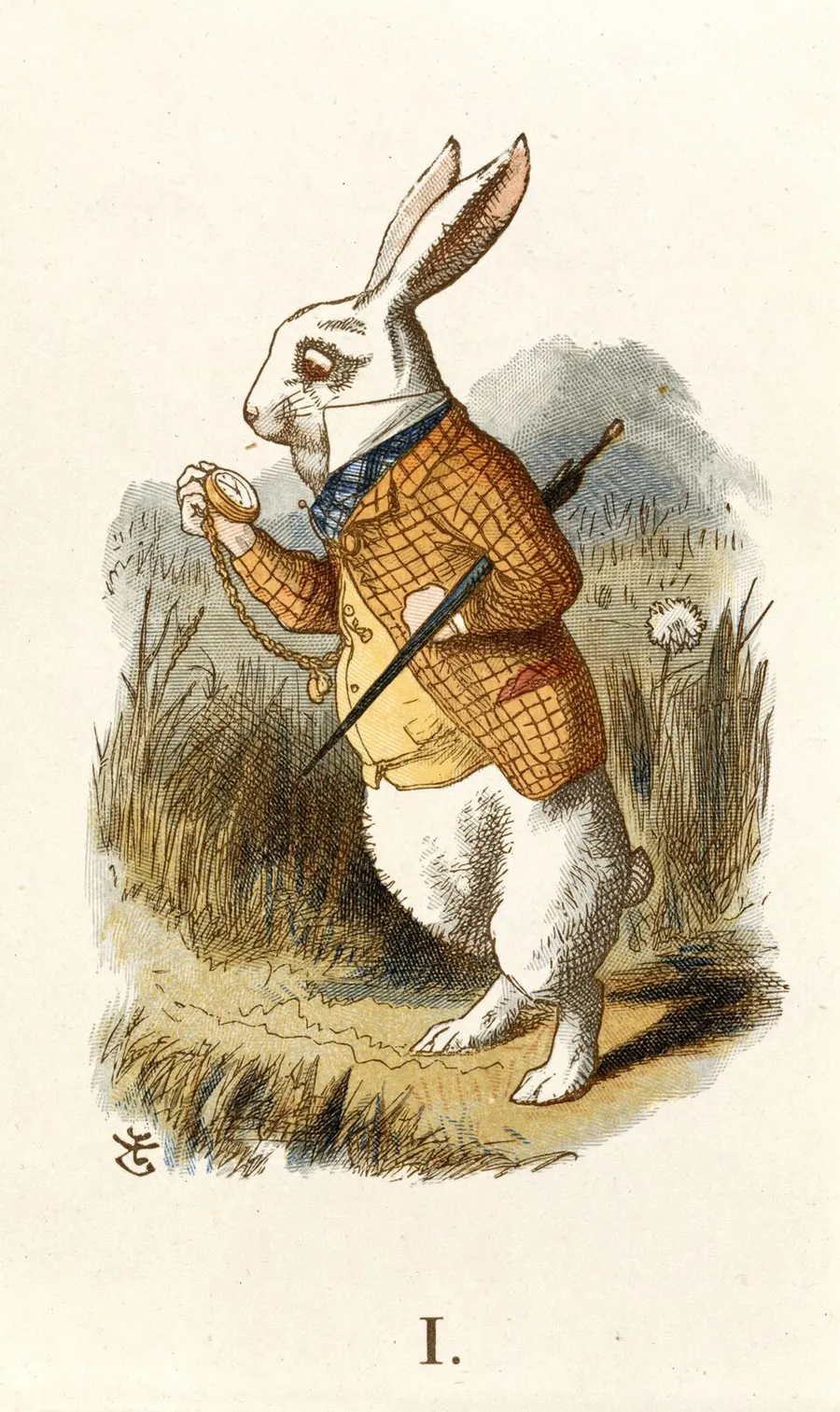
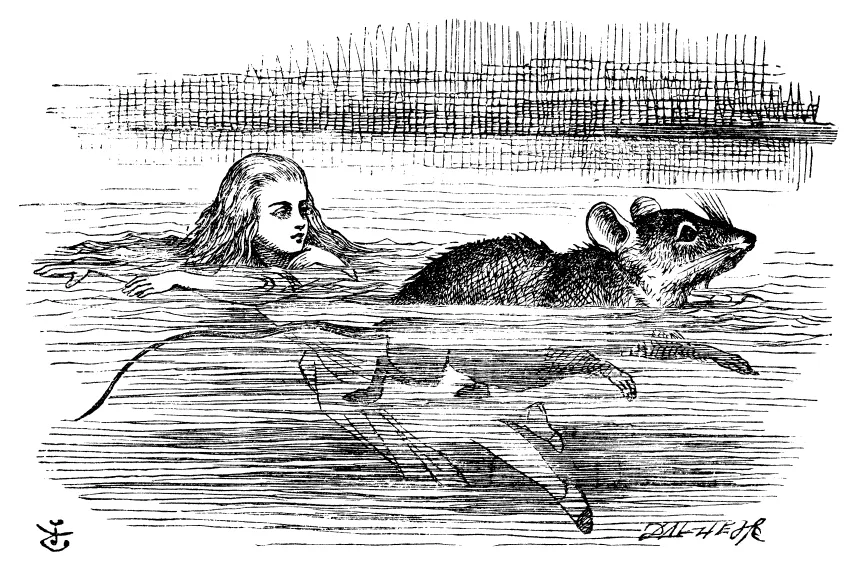
The White Rabbit (chapter I) — Tenniel, colored for The Nursery Alice (1890). Public domain (CC0).The Pool of Tears (chapter II) — John Tenniel, 1865. Public domain.
From a boat trip to a book
The story began as entertainment for the three Liddell sisters, Alice among them, on a rowing outing near Oxford on 4 July 1862. Alice Liddell asked Dodgson to write it down, and the expanded manuscript became the 1865 book under the Carroll pen name. Tenniel's original illustrations shaped every visual Alice since, including the ones people wrongly assume are Disney inventions, and they remain public domain alongside the text.
Why it survived when its imitators died
Victorian children's books moralized; Alice does not. Carroll's logician's humor — arguments that are formally valid and completely insane — gave the book a second audience that never outgrew it, and its dream structure gave adaptors a container that can be refilled endlessly. The result is that rarest publishing object: a 160-year-old children's book still in living, argued-about circulation rather than respectful storage.
Editions worth knowing
For free reading, Project Gutenberg's text is complete and clean. For print, the edition question is really an annotations question. Martin Gardner's The Annotated Alice remains the reference for readers who want the mathematics, logic, and Victorian in-jokes unpacked alongside the text. This site links no storefronts — the book is free, and edition choice beyond that is taste.
Book questions
Where can I read Alice in Wonderland free?
Project Gutenberg hosts the complete public-domain text of both Alice books, downloadable in every common format, and free audiobook recordings exist via LibriVox. No signup, no catch: this is what public domain means. Any site charging for the bare text is charging for convenience only.
What is the difference between Wonderland and Through the Looking-Glass?
Two separate books, six years apart, with different governing conceits. Wonderland (1865) runs on a playing-card court and dream-logic. Looking-Glass (1871) runs on a chess game played across a mirror world. The sequel is also where Tweedledum and Tweedledee, Humpty Dumpty's wordplay, the Jabberwocky poem, and the White and Red Queens come from. Most adaptations blend the two, which is why most people's remembered "Alice" is a composite.
What age is the book for?
Genuinely all-ages in the old sense. Read it aloud to children from roughly five up; the chapters are episodic and the set-pieces absurd. Confident readers manage it alone, and adults re-read it for the logic games and satire the child-listener sails past. Nothing in it needs content warnings beyond a beheading-obsessed queen nobody obeys.